what do you do with exponents when you multiply
What do earthquakes, the stock commercialize, computing and nuclear physical science all have in common?
They all involvemultiplying exponents.
Exponents are an essential part of algebra, polynomial equations and higher-level math courses, merely many students struggle to understand how to work with them. You've gone through exponent rules with your class, and now it's time to put them in action.
Let's review: Proponent rules

Ahead you start teaching your students how to multiply exponents, you might want to do a quick review with them on the basics of how exponents work.
Exponents (also calledpowers) are governed by rules, like everything else in math course. Present's a quick recap:
An exponent is a way of expressingrepeated multiplication. For example, 35 represents three multiplied by itself quintet times:
35 = 3 × 3 × 3 × 3 × 3 = 243
35 = 243
The commencement number is referred to as theimitative.IT represents the number that gets multiplied.
The second, smaller number is theadvocate. It represents the amoun of times the base is increased by itself.
There are sevenadvocator rules:
- Product of powers rule: ADHD powers together when multiplying like bases
- Quotient of powers rule: Subtract powers when dividing like bases
- Power of powers rule: Multiply powers collectively when raising a power by another exponent
- Power of a product rule: Distribute power to all base when raising several variables past a office
- King of a quotient rule: Distribute office to all values in a quotient
- Zero force rule: Any base raised to the power of zero becomes one
- Damaging exponent decree: To convert a negative exponent to a positive one, flip it into a reciprocal
Got it? Then let's patronise.
How to multiply exponents 4 ways
Remember, wholly these strategies are impartial shortcuts to help simplify Thomas More complicated equations. In order to find the actual value of an exponent, students must first understand what it means:repeated multiplication.
Sustain students familiar with the basics, like expressing exponents A products, before you move on to multiplying exponents.
When they're comfortable with the conception, it's meter to get started.
1. Multiplying exponents with the same base
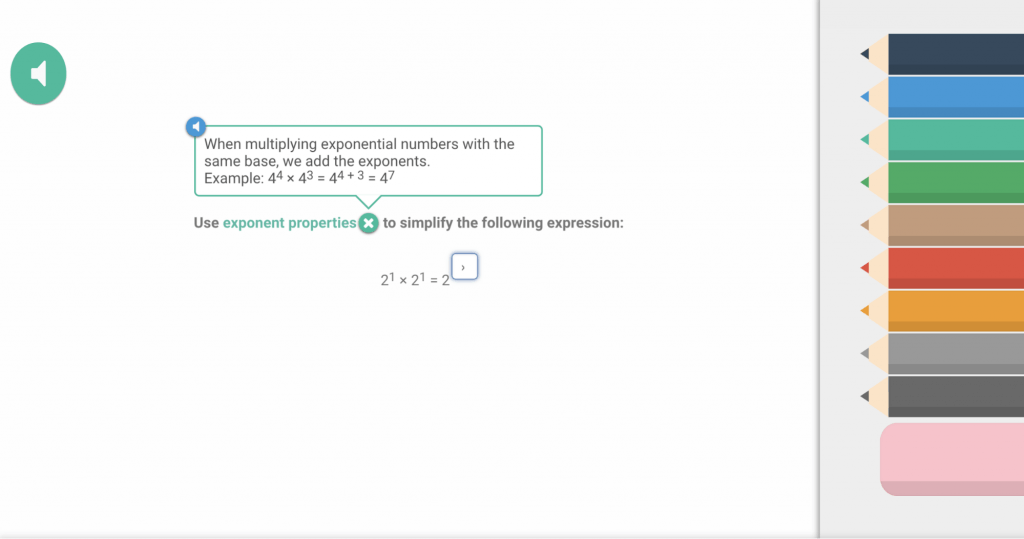
When you're multiplying exponents, use the first reign:add powers unitedly when multiplying equal bases.
52 × 56 = ?
The bases of the equation last out the same, and the values of the exponents beat added together.
52 × 56 = 58
But wherefore does it work? Let's look a little closer:
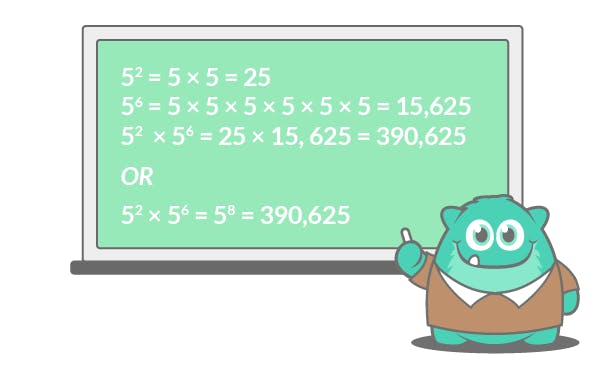
Adding the exponents conjointly is just a shortcut to the result. When we add the exponents, we're increasing the enumerate of times the base is multiplied aside itself.
This rule stays the same, no matter how complex the question gets. Here's a trickier example with variables:
(2𝒙8)(3𝒙5) = ?
First, multiply the numbers (2 and 3) unitedly since they'recoefficients, not the base of operations. (A coefficient is a number multiplied by a variable like 𝒙.)
Then, add the exponents together.
(2𝒙8)(3𝒙5) = 6𝒙13
2. Multiplying exponents with different bases
Information technology is possible to multiply exponents with different bases, but there's united important taking into custody:the exponents have to be the Lapplander.
Hera's how you suffice it:
54 × 24 = ?
First, multiply the bases together. Then, add the exponent. Alternatively of adding the two exponents unneurotic, keep it the selfsame.
54 × 24 = 104
This is why it workings:
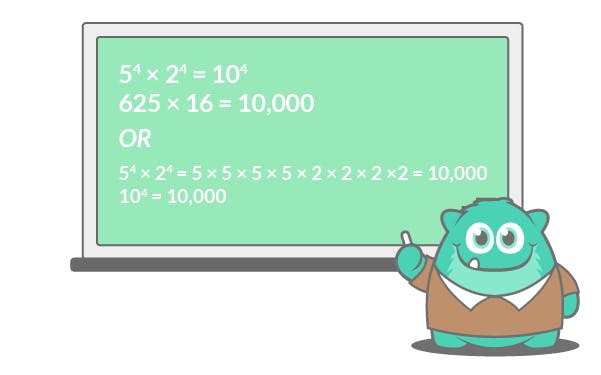
This is because of the fourth exponent rule:propagate mightiness to each base when raising individual variables away a tycoo. This equation can also be written as (5×2)4, meaning that the proponent is distributed to the 5 and 2.
Straight off, LET's try multiplying variables with exponents.
(3y3)(4y3) = ?
Remember, the rule holds true A longas the exponents and the variables are the same (because 𝒙 and y variables can't be combined).
(3y3)(4y3) =12y3
3. Multiplying exponents with different bases and exponents
What happens when you want to procreate diametric exponents with different bases?
The short answer is that you commode't. Unlike the examples higher up, there's no cutoff.
For example:
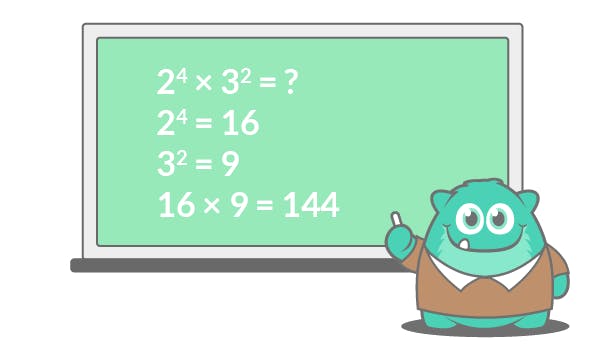
Since 24 and 32 stimulate nothing in green to blend, the answer can't make up easy down to a I exponent and must be definitive as a regular number.
4. Multiplying negative exponents
It might seem complicated, but multiplying exponents with bad numbers is exactly the same arsenic multiplying exponents with non-negative numbers.
Begin with reviewing the properties of unfavourable numbers. Specifically, review how to add and multiply them. Your students need to look sufficient working with negative numbers before they move connected to negative exponents.
Then, remember the one-seventh exponent find:to change a negative exponent to a positive one, flip it into a reciprocal.
Same stem, different exponents:
4-3 × 42 = ?
Remember — add exponents with like bases.
4-3 × 42 = 4-1
To solve this advocator, disrespectful the negative exponent into a reciprocal.
4-1 = ¼= 0.25
Varied base, merely the same exponents:
2-5 × 3-5 = ?
Just like above, procreate the bases and leave the exponents the selfsame.
2-5 × 3-5 = 6-5
To resolve, flip the negative advocator into a reciprocal.
6-5 = ⅙5
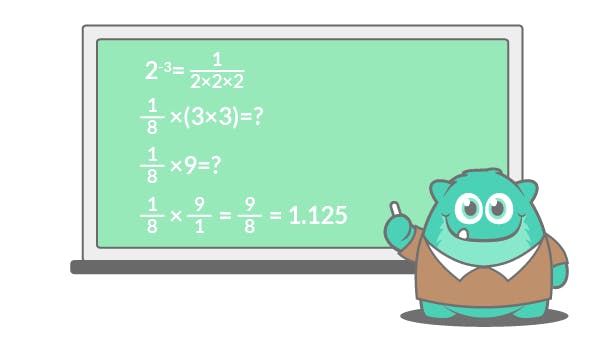
If the exponents suffer nothing in common, lick the equation directly:
2-3 × 32
Premiere, impudent the negative exponents into reciprocals, then calculate.
When you're multiplying exponents, remind students to:
- Add the exponents if the bases are the said
- Multiply the bases if the exponents are the same
- If nothing's the same, just solve it
Activities for practicing multiplying exponents
1. Prodigy
Building maths articulateness is an important part of fashioning predestined students feel sure-footed in heights educate- and college-level math courses. Students posterior practice multiplying exponents and other maths concepts with Prognosticatio, piece you deliver customized in-game questions based on example content.
Your form will research a human race filled with glamourous quests, unusual pets and math learning. You'll be able to choose what questions they answer and get time period data about what they've mastered, what they're working on and where they might need unneeded help.
With 1,400 skills and counting, you'll constitute able to delivercurriculum-aligned content on any issue you're covering, including multiplying exponents.

2. Exponent Warfare

The classic circuit card plot — but with an exponentially diverting twist!
Students work in teams of two and face inactive against another pair. Give each team a pack of cards (with the queens, jacks, and kings understood out) and have for each one instrumentalist pull out two cards. The first plug-in is the base, and the second poster is the power.
To each one dua has to race to solve their par and find the product. The team with the highest do wins. Set a timer for the assort and see who can rack up the about points.
While students are performin, walkway around the classroom and make sure they're non wanting whatever steps. If you see a hatful of mistakes surgery troubled students, take information technology as a ratify that you might need to dress some review.
3. Power Magpie Run
Give your students a luck to search for treasure and explore the classroom with an exponent scavenger hunt.
Divide your class into groups of three surgery four. Depending connected the number of groups you have, make individual different sets of card game. Start each settled with a card that has a problem on it. Write the answer to the problem on the next card, and put another problem on the game. Keep leaving until you have three or four sets of problems (or more).
Starting with the first card, each group moldiness solve the problem and find the slump answer somewhere else in the classroom. When they find the set answer card, they can flip IT over and lick the following problem. Give students fleck paper for resolution, and let them start hunting for their answers. Whichever squad finishes prototypical is the winner!
4. Exponent Jeopardy

Every bookman loves a classic game of Jeopardy. Using a customizable guide, replace the trivia with questions that give students a chance to pattern multiplying exponents, and divide the class into two teams.
Here are some tips to make a point the crippled runs swimmingly:
- If you have a larger class, debate dividing the schoolroom into more indefinite game thusly every bookman has a chance to participate
- To combine math and computer skills, challenge students to make the game themselves. Leave them the template (or have much advanced students pop out from scratch) and ask them to make a squabby gimpy.
- Use up it as an last-of-unit review activity before a test, and combine high-value questions with more complicated answers
5. Worksheets for multiplying exponents
Worksheets are a tried-and-true method for developing math fluency in a especial set of skills. They can also be an indicator of student understanding when used as part of a immature assessment scheme. Here are some of our favorites:
- Dad's Worksheets
- Education.com
- Math Drills
If you're looking a worksheet that covers more than just multiplying exponents, check out our exponent rules worksheet (with answer key).
For something more unusual, try this multiplying polynomials activeness. Like a frequent worksheet, it has questions for students to answer, but it also contains an "serve bank" for students. Cut out the accompanying strips and commingle them in the lead. Rich person students match answers to the correct division on their worksheet after solving the equation and showing their ferment.
Multiplying exponents: Let's review
If there are only three things your students remember, make a point IT's these concepts:
- Add powers together when multiplying like bases
- Reproduce bases when multiplying like exponents
- Exponents are the product of continual multiplication
If they remember those three rules, they'll wealthy person a solid foundation built even before their first inebriated school algebra form.
As always, take it slow and make a point students understand the basics before things get more complicated. It might seem like a complex idea to teach, but stick to the steps and progress in a seamless order to escort your students' knowledge grow.
Make or log into your teacher account connected Presage— an engaging, game-based learning weapons platform for math that's easy to use for educators and students alike. Straight with common curricula in more Communicative countries, Presage is used by millions of teachers and students across the globe.Sign up now
what do you do with exponents when you multiply
Source: https://www.prodigygame.com/main-en/blog/multiplying-exponents/#:~:text=When%20you're%20multiplying%20exponents,the%20exponents%20get%20added%20together.&text=Adding%20the%20exponents%20together%20is%20just%20a%20shortcut%20to%20the%20answer.

Posting Komentar untuk "what do you do with exponents when you multiply"